Guide
What to see in Lanzarote: 12 places, from Timanfaya to La Graciosa
What to see in Lanzarote: Timanfaya, Jameos del Agua, Cueva de los Verdes, Mirador del Río, Cactus Garden, La Geria, Teguise, La Graciosa, with prices.
In short
Lanzarote works best in blocks: the fire of Timanfaya and La Geria in the west, César Manrique's works in the north and centre, and the towns, beaches and La Graciosa on the coast. The Cabildo's CACT centres open every day of the year; Timanfaya costs 30 euros and the Cueva de los Verdes 17, and both can only be bought online.
Lanzarote is a small island with a volcanic landscape unlike any other: lava fields, vines planted in hollows, salt pans and a coast the sea batters hard. This guide brings together 12 places worth putting on your list, grouped by area so you can combine them in a single day.
Every figure we give (hours, prices, durations) comes from the official websites of the Cabildo and the Canary Islands Government, checked on 21 November 2026. Where only guides or press are available, we say so. Hours and fares change: confirm before you go.
Fire and vineyards: Timanfaya, La Geria and the Yaiza coast
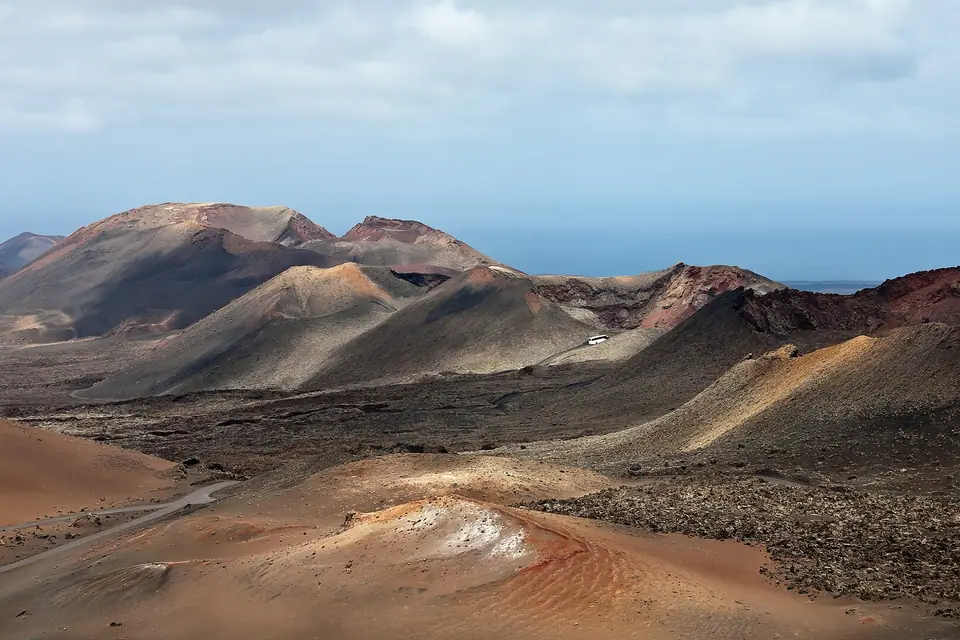
1. Timanfaya (Fire Mountains). It has been a National Park since Decree 2615/1974 of 9 August, with 5,107.50 hectares according to MITECO, and is part of the 1993 Biosphere Reserve. The CACT visit opens every day from 09:00 to 15:45, costs 30 euros (free for ages 0 to 6) and is sold online only, for a set date and time; you should arrive 15 minutes early and changes and refunds are not allowed. The route is the Route of the Volcanoes: a coach from Islote de Hilario, about 14 km, with an audio guide in Spanish, English and German, and geothermal demonstrations included. The website gives about 90 minutes for the visit in the listing and 1 hour 15 minutes in the visitor guide. Everyone in the vehicle, driver included, needs a ticket; you cannot walk in, and pets are not allowed (assistance dogs excepted). The El Diablo restaurant grills food over a five-metre well where the natural temperature is around 250 degrees; it takes no reservations.
2. La Geria. This is a Protected Landscape of 5,255.4 hectares spread across Yaiza, Tías, Tinajo, San Bartolomé and Teguise. The eruptions of 1730 to 1736 buried the farmland, and growers answered by digging hollows through the ash down to the buried soil: cones about 3 metres across, often with a low wall against the wind. Vines have been planted here since the 18th century and the most common variety is Malvasía. Turismo Lanzarote's directory lists 32 wineries, among them El Grifo, La Geria, Rubicón, Stratvs, Timanfaya and Vulcano. We have not checked each one's hours or tastings: ask at the winery.
3. El Golfo and Los Hervideros. These are two stops very close together in Yaiza, on the west coast. The Charco de los Clicos is a green lagoon beside the village of El Golfo, and Los Hervideros is a stretch of lava coast where the sea surges in when there is a swell.
4. Salinas de Janubio. A salt works that is back in operation; it looks best from above, from the hills on the road towards Playa Blanca, and the colour is strongest at sunset. For 3 and 4 there is no official listing with hours or fares for these places; the details come from the local information site Lanzarote.org and from guides, so confirm on the spot.
César Manrique in the north and centre: Jameos, Cueva de los Verdes, Mirador del Río and the Cactus Garden
5. Jameos del Agua. It is a section of the La Corona volcanic tube and the first Centre of Art, Culture and Tourism Manrique created. It opens every day from 10:00 to 18:00 (last admission 17:15); the general visit costs from 17 euros, free for ages 0 to 6, and takes 60 to 120 minutes. A blind crab endemic to the island (Munidopsis polymorpha) lives in the inner lake; the auditorium uses the acoustics of the volcanic chamber. On Fridays there are 'Noches de Jameos', with an evening visit, dinner and a concert. The Casa de los Volcanes is not included in the general ticket and adds about 60 minutes.
6. Cueva de los Verdes. It opens every day from 09:30 to 16:45 and costs 17 euros (free for ages 0 to 6). It is a guided visit of about 50 minutes, in Spanish and English, covering roughly one kilometre on foot with stairs and narrow passages; the whole tube is more than seven kilometres long. Tickets are sold online only, for a set date and time, and cannot be changed. In the 16th and 17th centuries, according to the CACT, locals used the galleries as a refuge from North African pirates.
7. Mirador del Río. It was dug into the ground and covered with volcanic stone, so it is barely visible from outside. Work began in 1971 and the centre opened in 1973. It opens every day from 10:00 to 17:00 (last entry 16:40), costs 9 euros (free for ages 0 to 6) and takes about 45 minutes. Two arched windows frame El Río and the Chinijo archipelago, with La Graciosa right in front of the cliff.
8. Cactus Garden. In Guatiza, on a former quarry: the terraces follow the contour of the excavation and the leftover basalt monoliths became sculptures. It opens every day from 10:00 to 17:00 (last entry 16:30), costs 9 euros (free for ages 0 to 6) and takes an hour. The CACT speaks of nearly 500 species; Turismo Lanzarote's site gives 450 species and about 4,500 cacti, so we do not quote a single figure. The gofio mill at the top is included in the ticket.
Towns and beaches: Teguise, Famara and Papagayo
9. Teguise. The Villa de Teguise was the island's capital from the early 15th century, until Arrecife replaced it, and its historic centre is a declared historic-artistic site. Every Sunday, from 9:00 to 14:00, there is a market with crafts and traditional produce. The 15th-century Castillo de Santa Bárbara stands on the Guanapay volcano with views over the town and much of the island, and is now a museum about piracy in the Canaries. The Palacio Spínola houses the Timple House Museum.
10. Famara. A large golden-sand beach running from Caleta de Famara to the slopes of the Risco, known for surfing: the village has schools and equipment hire. Turismo Lanzarote names it as one of the best places to watch the sunset, especially at low tide. It is open to the Atlantic: ask at the schools about sea conditions before you swim.
11. Papagayo. The Papagayo beaches lie in the Los Ajaches Natural Monument, in Yaiza. Access by car is charged per vehicle: a local outlet gave 3 euros in August 2026, with an exemption for residents and the car park closing at 19:00, but the fare is not given by an official source. Some guides say you can walk from Playa Blanca in 30 to 45 minutes.
By sea: La Graciosa
12. La Graciosa. You get there by boat from Órzola: according to Turismo Lanzarote there are departures roughly every 30 minutes, and the Biosfera Express website gives an average crossing of 25 minutes and about 6 km. It has no asphalted roads and the island is part of the Chinijo Archipelago Marine Reserve, of 70,700 hectares. Full details (boats, beaches, rules) are in our La Graciosa guide.
To combine stops. Stops in the same area fit well into one day: Timanfaya with La Geria; Jameos, Cueva de los Verdes and Mirador del Río in the north; or Teguise with the Cactus Garden. We give no driving times between them because we could not verify them from an official source.
Tickets, hours and discounts
The Cabildo's CACT centres open every day of the year. Published hours: Timanfaya 09:00 to 15:45, Jameos del Agua 10:00 to 18:00, Cueva de los Verdes 09:30 to 16:45, Cactus Garden and Mirador del Río 10:00 to 17:00, Casa Museo del Campesino 10:00 to 18:00 and Castillo de San José (MIAC) 11:00 to 18:00. Timanfaya and the Cueva de los Verdes are sold online only; the others have a box office, though buying ahead is recommended.
There are reduced rates for Canary Islands residents, Lanzarote residents and people with disabilities; they cannot be combined and apply only at the box office with the documents. The Casa Museo del Campesino, in Mozaga, has free admission, and the Castillo de San José costs 5.40 euros.
Official sources
Written by us from these sources, consulted up to 25 November 2026. Rules and traffic restrictions change: check them before you travel.
- CACT Lanzarote: centres, hours and prices
- CACT Lanzarote: Montañas del Fuego (Timanfaya)
- CACT Lanzarote: Jameos del Agua
- CACT Lanzarote: Cueva de los Verdes
- CACT Lanzarote: Jardín de Cactus
- CACT Lanzarote: Mirador del Río
- CACT Lanzarote: Casa Museo del Campesino
- CACT Lanzarote: Castillo de San José (MIAC)
- MITECO: Timanfaya, fact sheet
- Canary Islands Government (CanariWiki): La Geria
- Turismo Lanzarote: wineries
- Turismo Lanzarote: Teguise, Famara and the Cactus Garden
- Turismo Lanzarote: La Graciosa and Marine Reserve
- Biosfera Express: Órzola–La Graciosa
- Lanzarote.org: Janubio salt pans
- Living Lanzarote: access to Papagayo
Frequently asked questions
What should you see first on Lanzarote?
Timanfaya, the volcano National Park, which has been part of the Biosphere Reserve since 1993. After that, César Manrique's works: Jameos del Agua, the Mirador del Río and the Cactus Garden.
Do I need to book Timanfaya and the Cueva de los Verdes?
Yes: according to the CACT both tickets are sold online only, for a set date and time, and cannot be changed. You must arrive 15 minutes early.
Do the centres open every day?
The CACT centres we checked say they open every day of the year; closing times vary, from 15:45 at Timanfaya to 18:00 at Jameos and the Casa Museo del Campesino.
Is there anything free to see?
The Casa Museo del Campesino, in Mozaga, has free admission according to the CACT. Children aged 0 to 6 enter the other centres free.
Can I enter Timanfaya in my own car?
According to the CACT, everyone in the vehicle needs a ticket and you cannot walk in. The visit includes the Route of the Volcanoes coach tour, about 14 km, from Islote de Hilario.
Atlas de Lanzarote editorial team · reviewed on 25 November 2026
More guides
- César Manrique in Lanzarote: what to visit, from the Foundation to the Cabildo centres
- Jameos del Agua tickets and the Cabildo centres: prices, opening hours and booking
- Ferry from Lanzarote to Fuerteventura: operators, crossing time, car and the Isla de Lobos permit
- La Graciosa from Lanzarote: ferries from Órzola, beaches and island rules
- Lanzarote in winter: November to March weather, what is open, Christmas, Three Kings and Carnival
- Best beaches in Lanzarote: Papagayo, Famara, Puerto del Carmen and the Blue Flag ones
- Lanzarote in the rain: what to do
- Lanzarote with kids: what to do
- Free and cheap plans on Lanzarote
- Relaxed plans on Lanzarote, no effort needed