Guide
César Manrique in Lanzarote: what to visit, from the Foundation to the Cabildo centres
César Manrique on Lanzarote: the Foundation in Tahíche and Haría (€10 each, €17 joint), Jameos del Agua, Mirador del Río, Cactus Garden and an order.
In short
César Manrique (Arrecife, 1919 – 1992) left Lanzarote two Foundation museums, in Tahíche and Haría (10 euros each, 17 for the joint ticket), and several Cabildo Centres of Art, Culture and Tourism, such as Jameos del Agua, the Mirador del Río and the Cactus Garden. The island has been a UNESCO Biosphere Reserve since 7 October 1993.
It is hard to travel around Lanzarote without running into César Manrique. A painter, sculptor and architect, he returned to the island in the 1960s and left a way of building with the landscape that you can now visit in museums, gardens, caves and viewpoints. This guide explains what belongs to the César Manrique Foundation and what belongs to the Cabildo's centres, and suggests an order for seeing them.
Hours and prices come from the official websites of the Foundation and the CACT, checked on 21 November 2026. We checked the dates of his life against the Foundation's website and an encyclopedia; where something is not on record, we say so.
Who he was: a short biography
Manrique was born on 24 April 1919 in Arrecife. He studied at the San Fernando Fine Arts Academy in Madrid, where he lived from 1945 to 1964; in the early 1950s he began making non-figurative art. In 1964 he moved to New York, where he held three solo shows at the Catherine Viviano gallery, and in the mid-1960s he returned to Lanzarote to start his landscape and spatial projects.
He died on 25 September 1992, aged 73, in a traffic accident near the headquarters of the foundation that bears his name, in the municipality of Teguise. The Foundation's website gives the years of his birth and death; the exact day and place we took from the Spanish Wikipedia.
What belongs to the César Manrique Foundation
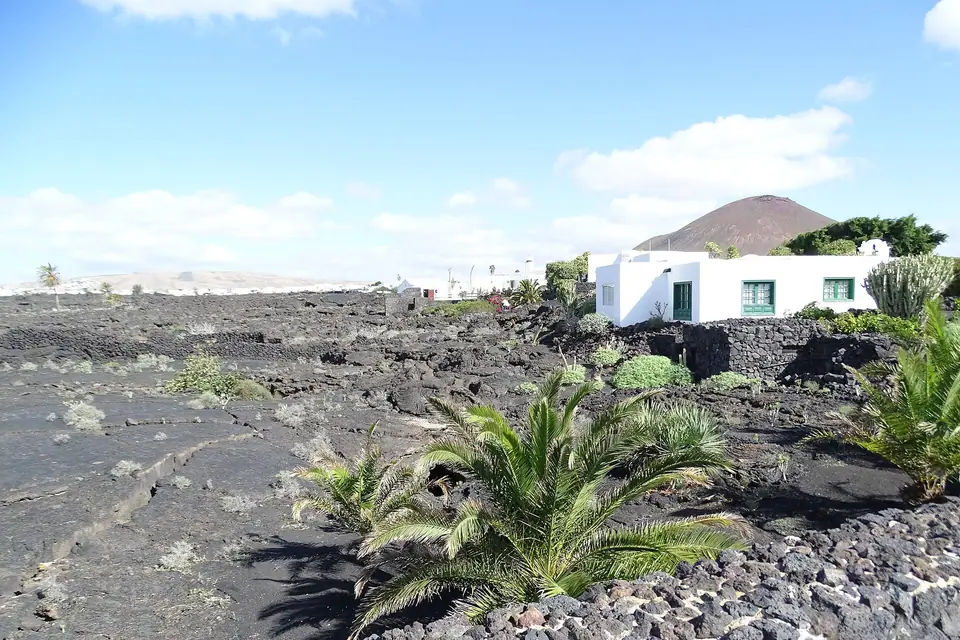
The Foundation runs two house museums. The one in Tahíche (Taro de Tahíche) is the house Manrique designed himself on returning from New York and where he lived from 1968 to 1988. It stands on a lava flow from the 1730 to 1736 eruptions, covers about 3,000 m² on a 30,000 m² plot, and its lower floor is organised around five volcanic bubbles linked by tunnels dug through the lava; the upper floor draws on the island's traditional architecture. It opens every day of the year, 10:00 to 17:30 (the ticket desk closes at 17:00), except 1 January, and costs 10 euros (3 euros for ages 7 to 12, with documentation).
The César Manrique House Museum, in Haría (calle Elvira Sánchez, 70), opens every day from 10:30 to 17:30 (ticket desk until 17:00), except 1 January, and costs 10 euros (3 euros for ages 7 to 12). The joint ticket for the two museums costs 17 euros (4 euros for ages 7 to 12) and you have 15 days to visit the second.
What belongs to the Cabildo's centres (CACT)
The Cabildo's Centres of Art, Culture and Tourism bring together the public sites associated with Manrique. According to their official listings:
Jameos del Agua is the first centre Manrique created: it opened in 1968 and his intervention was completed in 1977, with the collaboration of Jesús Soto. It opens 10:00 to 18:00 and costs from 17 euros. The Mirador del Río, which he conceived and carried out with Eduardo Cáceres and Jesús Soto, was begun in 1971 and opened in 1973 (10:00 to 17:00, 9 euros). The Cactus Garden, in Guatiza, is one of his last major works on the island: his team planted the first Euphorbia candelabrum on 18 January 1989 (10:00 to 17:00, 9 euros).
The Casa Museo del Campesino, in Mozaga, grew out of a 1968 project as a tribute to Lanzarote's farming knowledge; the sculpture 'Fecundidad', the monument to the farmer, stands apart, on the Peña de Tajaste (10:00 to 18:00, free admission). The Castillo de San José, in Arrecife, is an 18th-century fortress that has housed the MIAC since 1976; Manrique proposed restoring it in the mid-1970s and directed the remodelling (11:00 to 18:00, 5.40 euros). Montañas del Fuego (Timanfaya) appears among the key works on the Foundation's website (09:00 to 15:45, 30 euros).
One clarification: the Cueva de los Verdes also belongs to the CACT, but its listing says the Cabildo commissioned Jesús Soto to adapt it in the 1960s; we do not attribute it to Manrique.
The UNESCO Biosphere Reserve (1993)
Lanzarote was declared a Biosphere Reserve by UNESCO on 7 October 1993, and the declaration covers the whole island, with all its population centres, according to the Canary Islands Government. The Cabildo explains that UNESCO accepted into its network an island that already had a lot of tourist activity because the 1991 Island Planning Scheme curbed the expansion of tourist accommodation and disqualified about 250,000 tourist beds.
No official source links the designation to a specific work by Manrique, so we do not claim that link; what is on record is that the MITECO fact sheet for Timanfaya National Park lists the Biosphere Reserve as 1993.
Suggested order
1. Start with the Foundation in Tahíche: it is the house where he lived and helps make sense of the rest. If you also want the one in Haría, the joint ticket (17 euros) is valid for 15 days.
2. Continue in the north with Jameos del Agua and the Mirador del Río; the Cueva de los Verdes fits the same day, even though it is not his work. Remember the Cueva is bought online only.
3. Add the Cactus Garden, in Guatiza, and the Casa Museo del Campesino, in Mozaga, which is free.
4. Keep the Castillo de San José (MIAC), in Arrecife, and Timanfaya, whose ticket is online only, for another day. This is a reading order, not a measured route: we give no driving times because we could not verify them.
Official sources
Written by us from these sources, consulted up to 21 November 2026. Rules and traffic restrictions change: check them before you travel.
- César Manrique Foundation: home, hours and prices
- César Manrique Foundation: Tahíche house
- César Manrique Foundation: biography
- Wikipedia (es): César Manrique
- CACT Lanzarote: centres, hours and prices
- CACT Lanzarote: Jameos del Agua
- CACT Lanzarote: Cueva de los Verdes
- CACT Lanzarote: Jardín de Cactus
- CACT Lanzarote: Mirador del Río
- CACT Lanzarote: Casa Museo del Campesino
- CACT Lanzarote: Castillo de San José (MIAC)
- Canary Islands Government: Lanzarote Biosphere Reserve
- Cabildo de Lanzarote: Biosphere Reserve
- MITECO: Timanfaya, fact sheet
Frequently asked questions
When was César Manrique born and when did he die?
He was born on 24 April 1919 in Arrecife and died on 25 September 1992 in a traffic accident in Teguise, according to the Spanish Wikipedia; the Foundation's website confirms 1919 and 1992.
What is the difference between the César Manrique Foundation and the Cabildo centres?
The Foundation runs two house museums: Tahíche and Haría. The Cabildo's Centres of Art, Culture and Tourism (CACT) include Jameos del Agua, the Mirador del Río, the Cactus Garden, the Casa Museo del Campesino, the Castillo de San José and others. The tickets are separate.
Is there a joint ticket for the Foundation's two museums?
Yes: it costs 17 euros (4 euros for ages 7 to 12) and you have 15 days to visit the second museum, according to the Foundation's website.
Where did Manrique live on Lanzarote?
In the Taro de Tahíche from 1968 to 1988, and he also had a house in Haría, now a house museum. The Foundation's website does not say from which year he lived in Haría.
When did Lanzarote become a Biosphere Reserve?
On 7 October 1993, according to the Canary Islands Government; it covers the whole island.
Atlas de Lanzarote editorial team · reviewed on 21 November 2026
More guides
- Jameos del Agua tickets and the Cabildo centres: prices, opening hours and booking
- Ferry from Lanzarote to Fuerteventura: operators, crossing time, car and the Isla de Lobos permit
- La Graciosa from Lanzarote: ferries from Órzola, beaches and island rules
- Lanzarote in winter: November to March weather, what is open, Christmas, Three Kings and Carnival
- Best beaches in Lanzarote: Papagayo, Famara, Puerto del Carmen and the Blue Flag ones
- What to see in Lanzarote: 12 places, from Timanfaya to La Graciosa
- Lanzarote in the rain: what to do
- Lanzarote with kids: what to do
- Free and cheap plans on Lanzarote
- Relaxed plans on Lanzarote, no effort needed